What do a decade of lineups from the world’s top multi-genre festivals reveal about the state of music today? Between 2015 and 2025, the sound of music festivals has evolved—reflecting deeper shifts in the industry and culture. This analysis uncovers the rise and fall of genres, key regional differences, and what it all says about the changing identity of the modern festival.
This is part one of a four-part series, beginning with a macro look at the major U.S. festivals.
Rock remains the most booked genre at U.S. festivals — thanks in part to Summerfest’s scale and rock-heavy lineups. But when Summerfest is removed from the data, Electronic takes the lead for the first time, signaling a major shift in genre dominance. Meanwhile, Hip-Hop, which peaked in 2022–2023, has seen a measurable pullback since. The past decade marks a clear turning point.
This analysis draws on genre breakdowns from major U.S. music festivals over a 10-year period (2015–2025). Data was compiled from artists who were officially booked and announced as part of each festival’s lineup and supplemented with genre classifications from Booking Agent Info, and using Apple Music as a tiebreaker in multi-genre edge cases. Each artist was assigned to a single primary genre for clarity and consistency. This analysis measures programming trends — not artist performance, attendance, or ticket sales.
We selected festivals using the following criteria:
The following seven U.S. festivals met these criteria and were included in this analysis:
Coachella, Lollapalooza, Bonnaroo, Austin City Limits (ACL), Outside Lands, Governors Ball, and Summerfest.
Summerfest is one of the largest festivals by attendance in the United States and has been active throughout the decade. However, its genre balance differs significantly from other major festivals — particularly with its low representation of Electronic music. This has a measurable impact on the genre trendlines.
To address this, we’ve included a separate “What If?” analysis in the report to show how excluding Summerfest affects the broader picture.
This comparative view helps underscore how a single large festival can shape—or skew—perceptions of national genre dominance. Its scale and programming lean heavily toward Rock, which can obscure national growth in genres like Electronic and Hip-Hop when included.
Before diving into which genres are dominating U.S. music festivals, it helps to understand the broader trend in how festivals are booking talent overall.
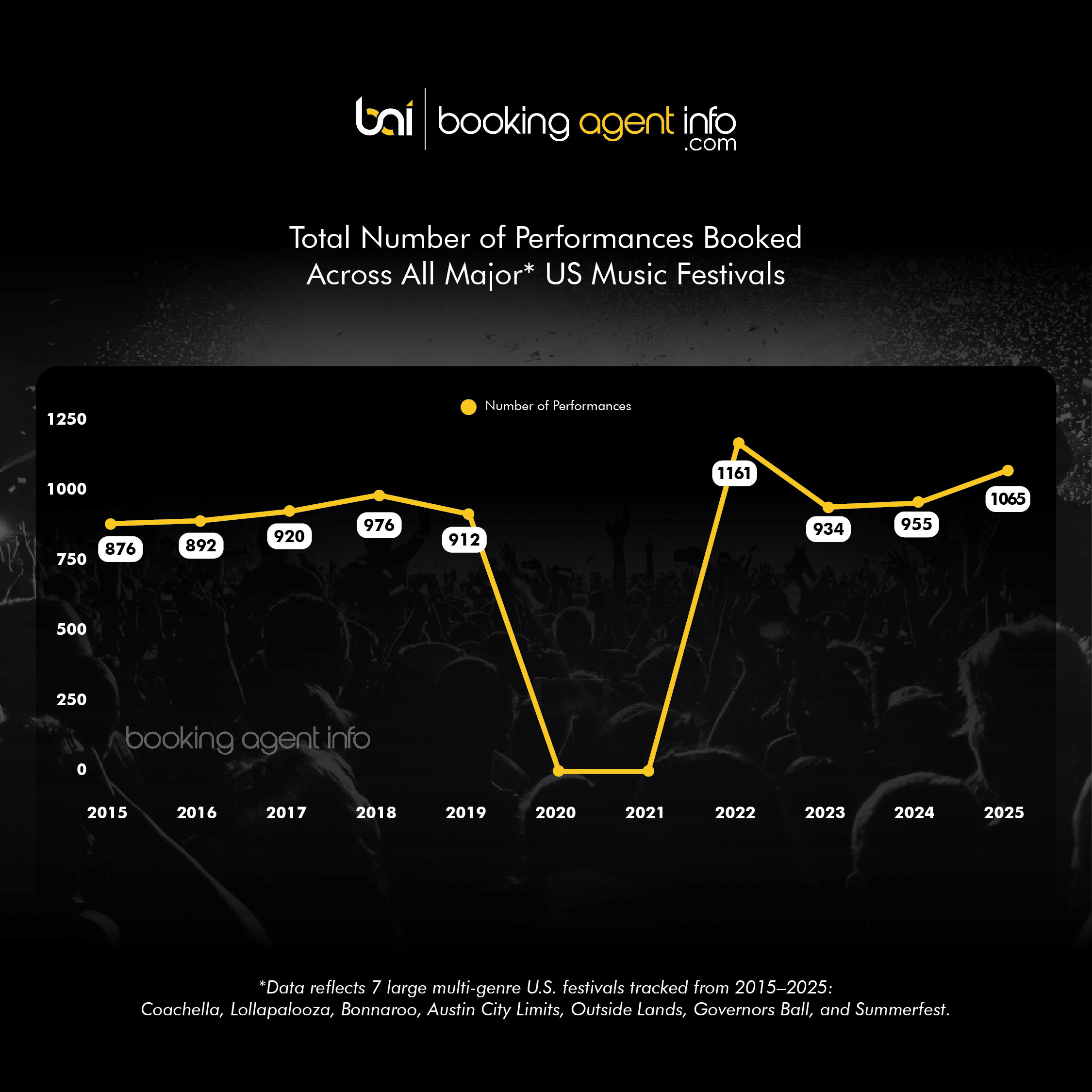
Despite a pandemic-induced collapse in 2020 and 2021, both the total number of performances and the number of unique artists performing at major U.S. festivals have steadily climbed over the past decade. In 2022, the industry rebounded dramatically, and while the years since haven’t matched the same post-pandemic spike, the long-term trend points upward.
This shows a clear increase in bookings over time, with some annual fluctuations and a major pandemic dip. The return in 2022 marked the highest number of performances in the dataset.
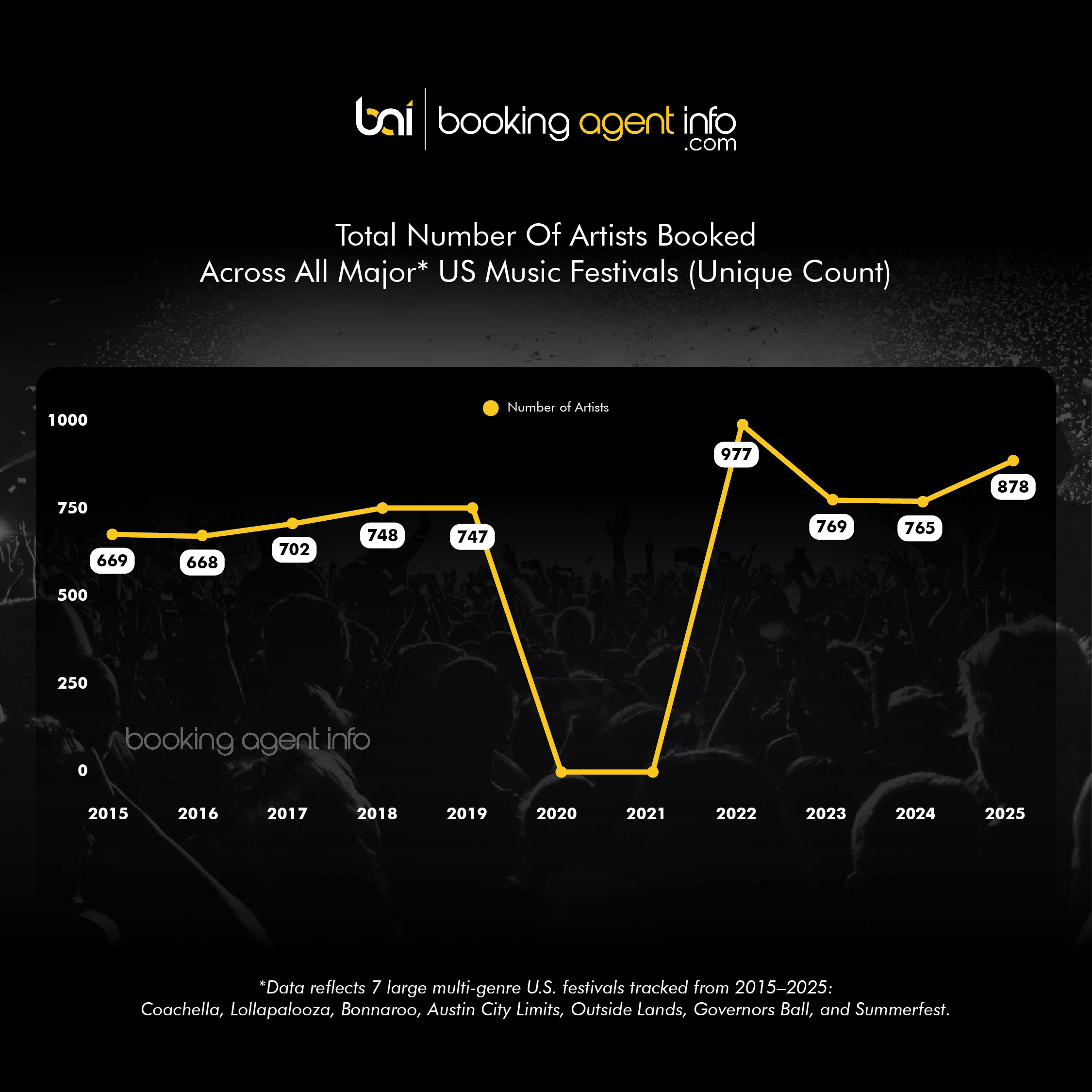
Not only are more performances being booked, but the diversity of artists is growing too. The total number of unique artists per year has also increased since 2015, with 2022 marking the biggest year yet. This suggests festivals are not just recycling the same names—they’re casting a wider net.
These changes set the stage for deeper questions: Who’s being booked more? Which genres are rising? And which are slowly disappearing from the spotlight?
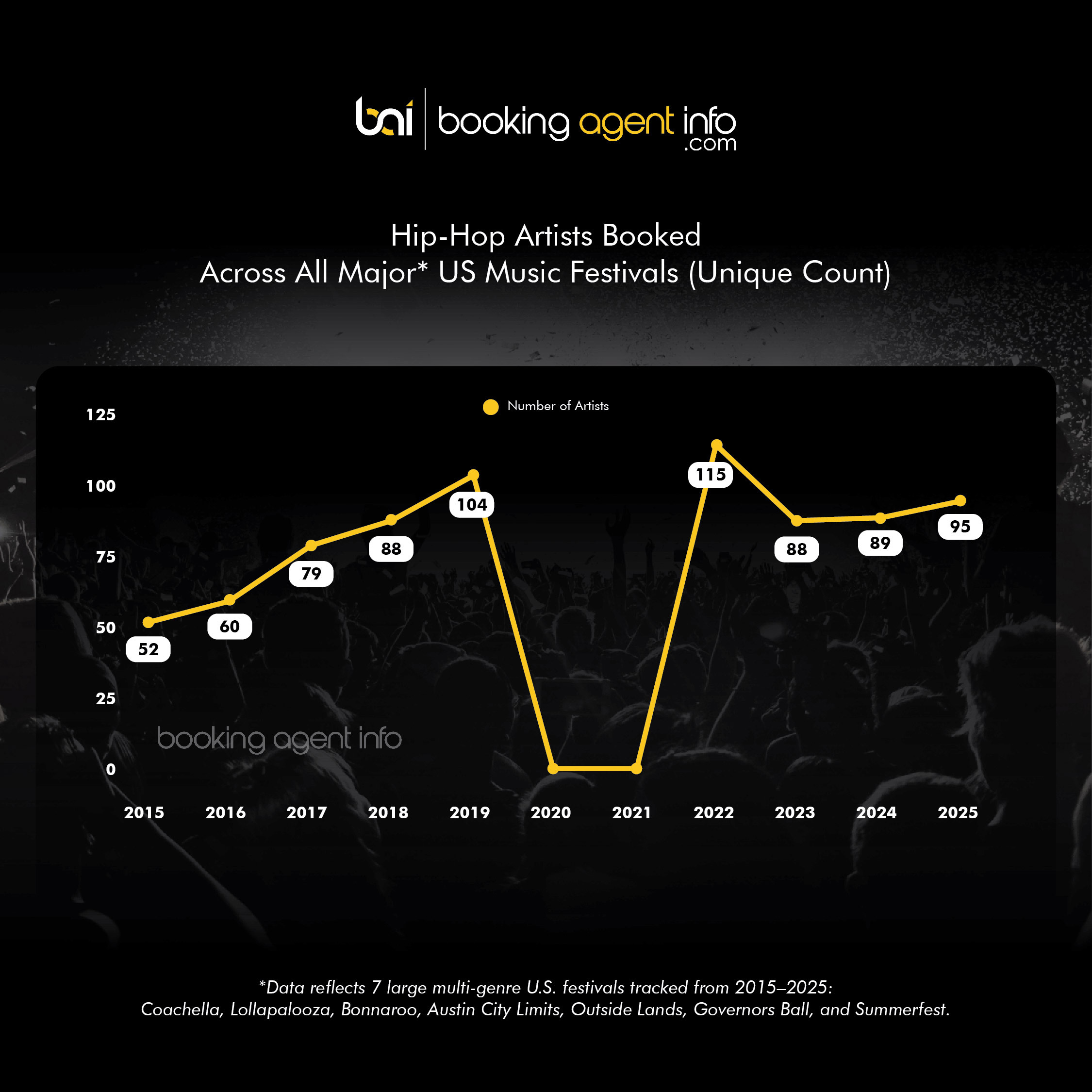
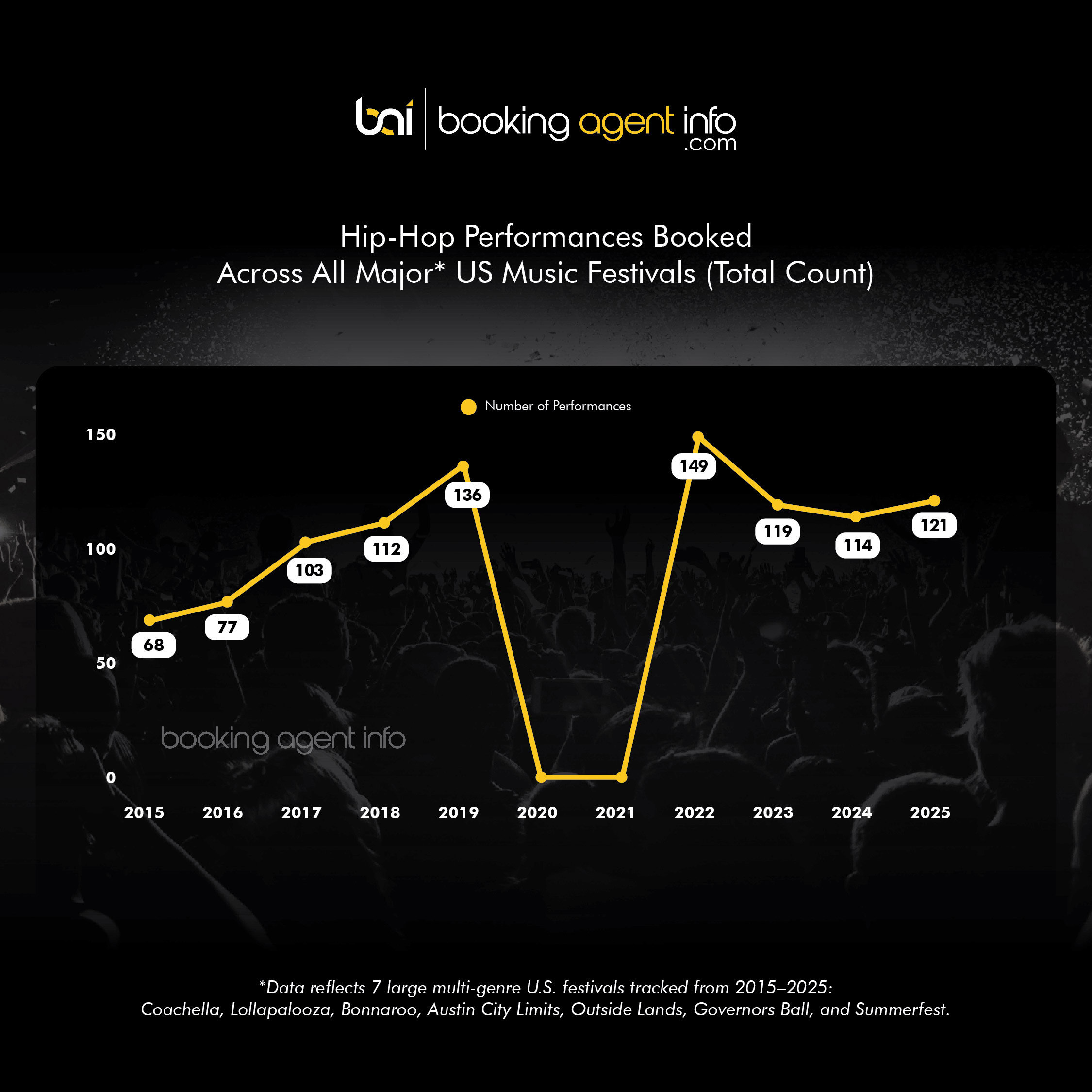
Hip-Hop didn’t just break into the festival circuit — it reshaped it. By the start of the dataset in 2015, it was already a dominant headlining genre, anchoring top slots at Coachella, Lollapalooza, and beyond. Over the next few years, its festival footprint grew rapidly, mirroring its chart dominance and cultural influence. But after reaching a post-pandemic high in 2022, the genre’s festival presence has subtly — but clearly — pulled back.
In 2015, there was just 68 Hip-Hop performances across major U.S. multi-genre festivals by 52 unique artists. By 2019, those numbers had doubled. And by 2022, Hip-Hop peaked with 149 performances and 115 unique artists—its loudest, most dominant year yet.
Since then? A quiet pullback. In 2025, bookings dropped to 121 performances and 95 unique artists. Still strong—but down from the highs.
To be clear, Hip-Hop’s cultural influence is still enormous—festivals like Rolling Loud and Lyrical Lemonade’s Summer Smash draw massive crowds with rap-focused lineups. But in the context of large-scale, multi-genre festivals, the numbers suggest the genre may be settling into a steadier rhythm.
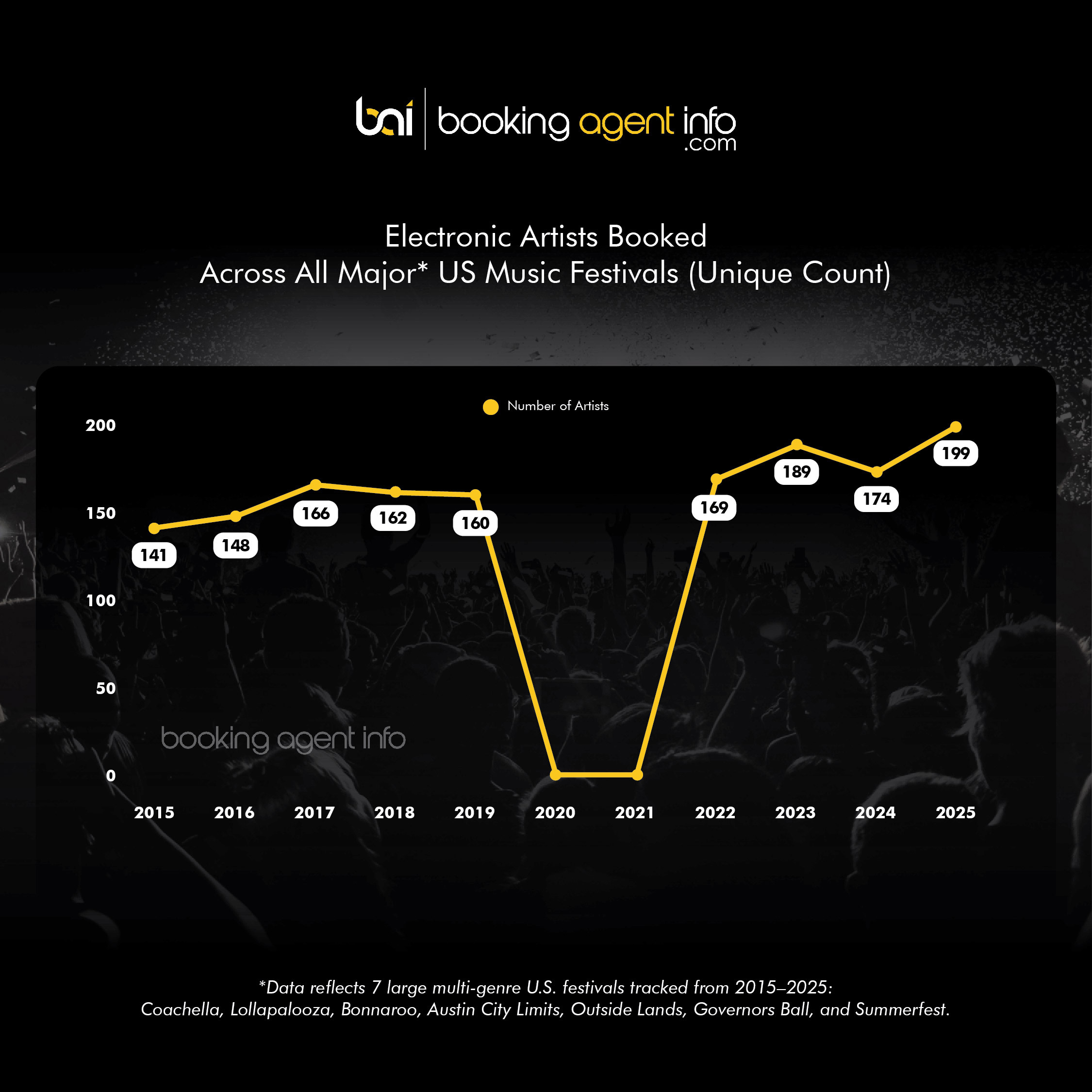
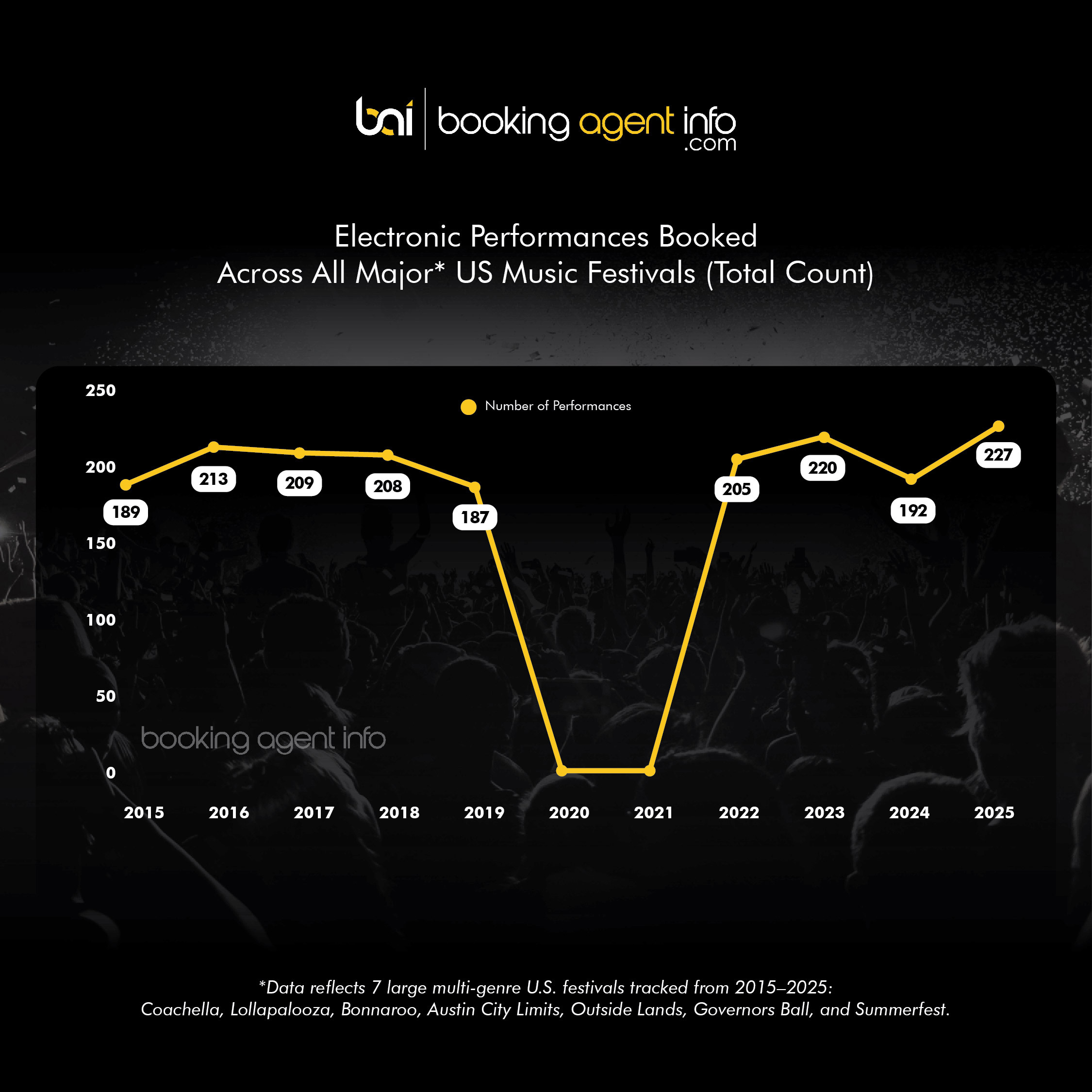
Electronic music didn’t just survive the decade — it thrived. What began as a strong, club-ready genre in the early 2010s has become one of the most booked genres in U.S. multi-genre festivals by 2025. It held steady through the pre-pandemic years, stumbled during COVID, and then returned with force.
In 2015, there were 189 electronic performances by 141 unique artists. After peaking at 213 performances in 2016, it was trending downward before the pandemic. Then came the resurgence: 205 performances and 169 unique artists in 2022, soaring to 227 performances and 199 unique artists by 2025 — the highest in the dataset.
This trajectory mirrors the broader post-pandemic appetite for high-energy, immersive live experiences. Electronic music — from EDM to techno to bass-heavy hybrids — offered festivalgoers the escape and euphoria they were craving.
Note: Electronic becomes the most booked genre when Summerfest is excluded
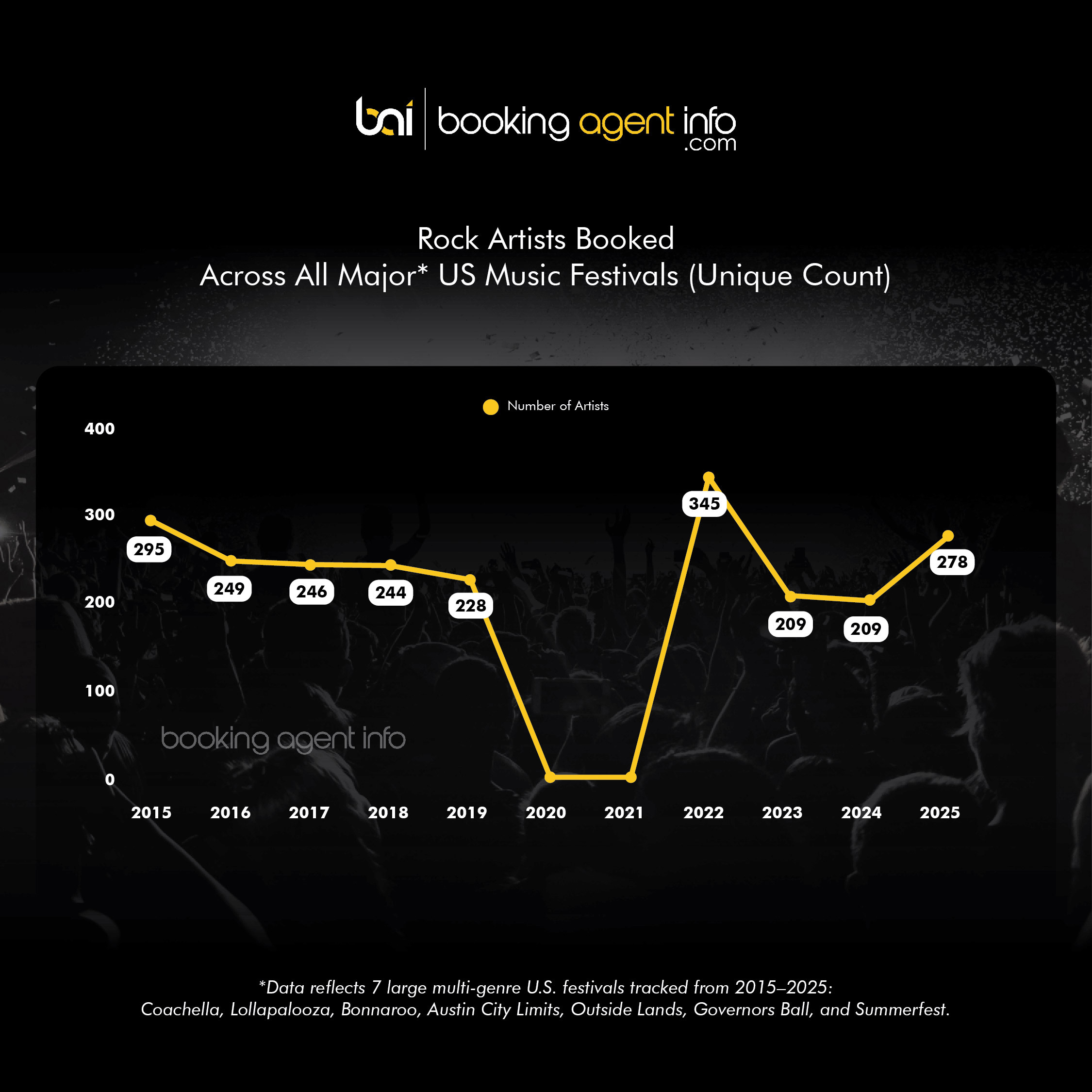
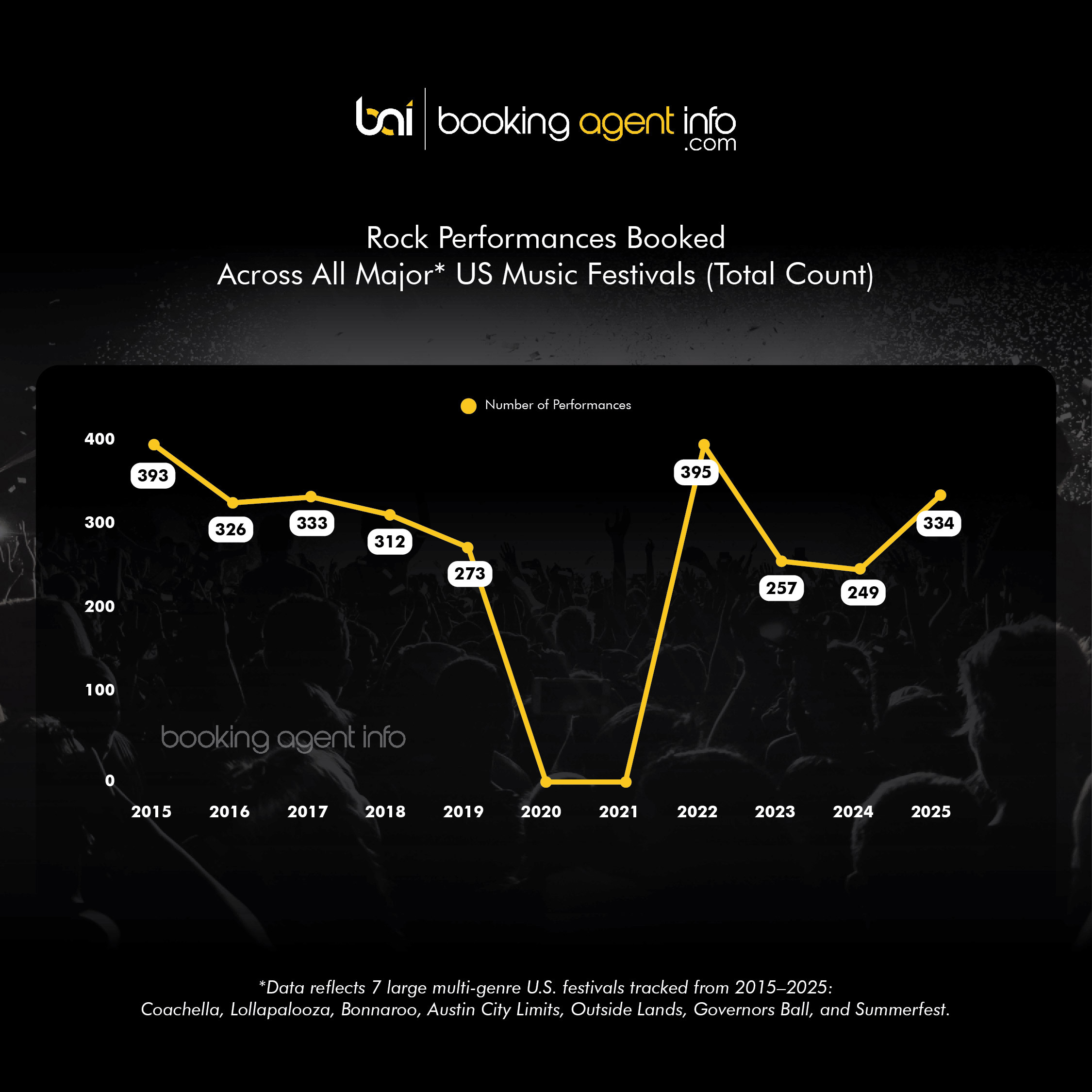
Rock may not dominate headlines like Hip-Hop or set social media ablaze like Electronic — but it continues to dominate U.S. festival lineups. In raw numbers, no genre came close over the past decade.
In 2015, Rock claimed 393 total performances, with 295 unique artists — the highest across the board. That dominance persisted year after year, bolstered in part by the sheer scale of Summerfest, which leans heavily Rock. Even after the 2020–2021 pandemic dip, Rock came roaring back with 395 performances in 2022, edging out every other genre again.
But the trendline tells a subtler story.
From 2015 to 2024, Rock lost over 90 unique artists and nearly 150 performances. In 2023, for the first time in the decade, Rock was nearly overtaken by Electronic in unique bookings — and without Summerfest in the mix, Electronic would have claimed the top spot in 2025.
So Rock is still king. But its crown is heavier than ever — and not all festivals are carrying the weight. Niche rock events like Louder Than Life, Aftershock, and Rock Fest continue to thrive, but in multi-genre lineups, Rock is gradually ceding space to the sounds of the next generation.
The decline isn’t dramatic. But it’s real.
Pop has never been the flashiest genre at U.S. festivals — no niche crowds in matching vests, no all-night tent raves — but it remains the industry’s workhorse. What it lacks in cult followings, it makes up for in cultural pervasiveness. And its trajectory over the last decade reflects that quiet dominance.
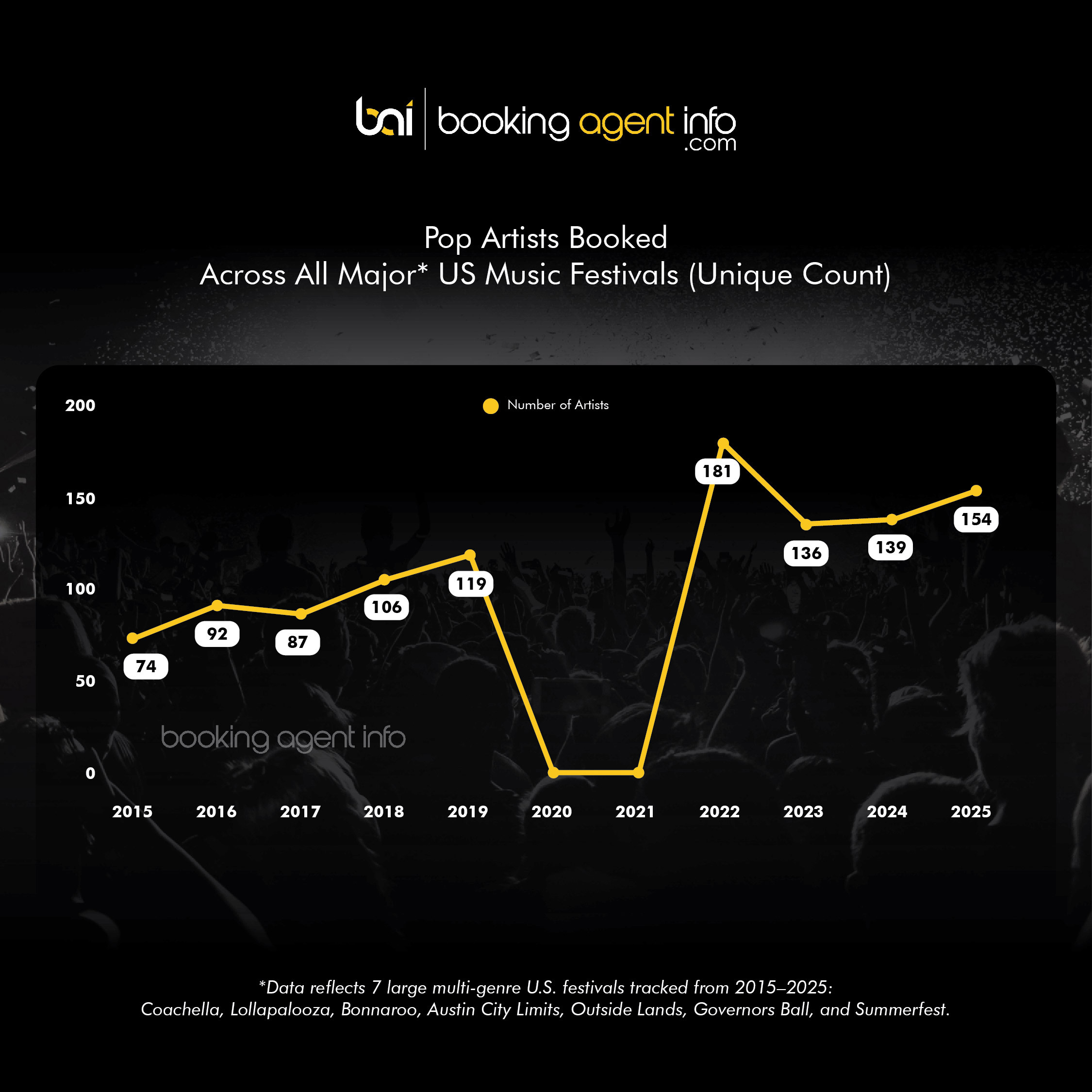
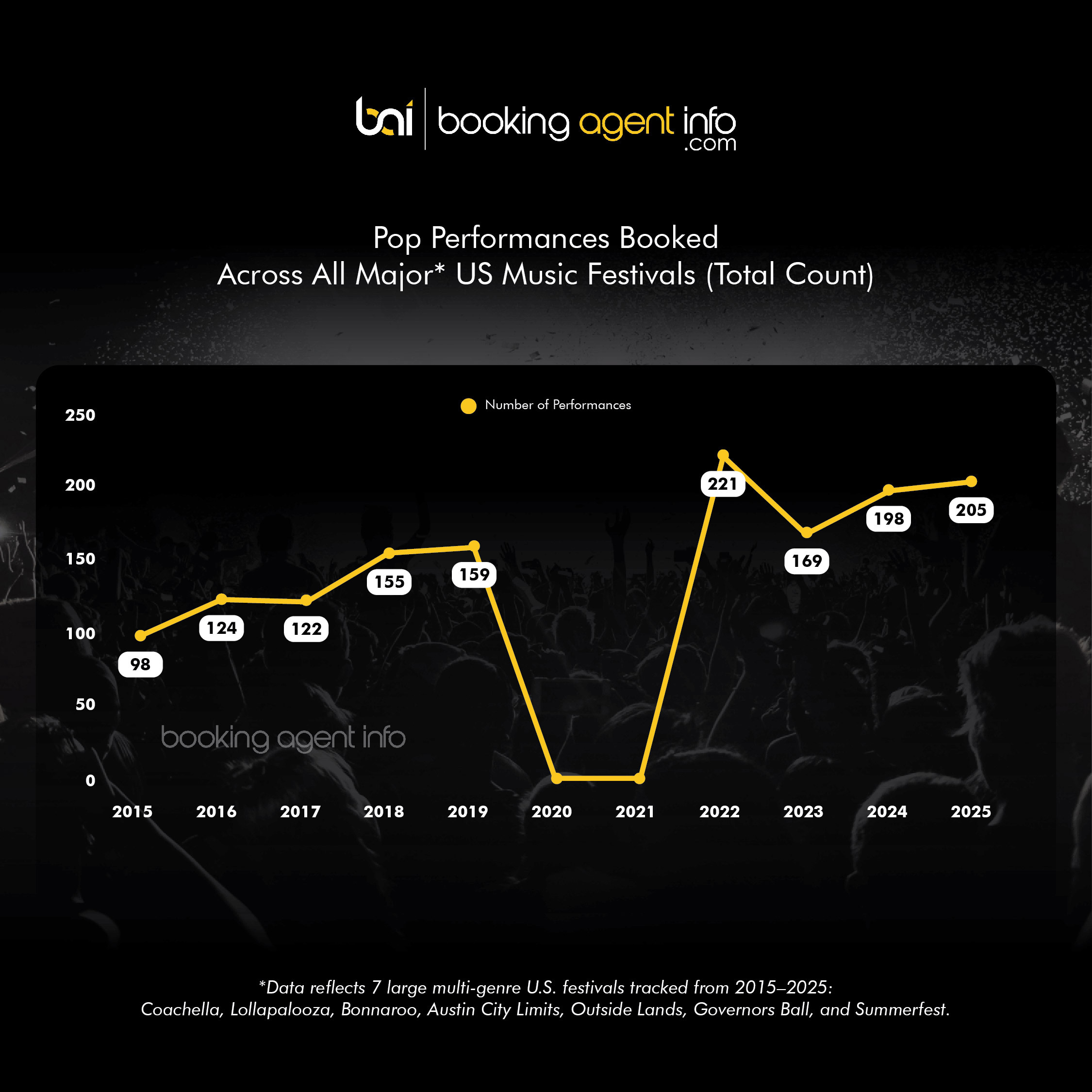
In 2015, pop counted 98 performances across the major festivals we analyzed. By 2019, it had climbed to 159 — not explosive, but steady. Then came the pandemic reset. But while some genres stumbled on the way back, pop returned with force: 221 performances and 181 unique artists in 2022, its biggest year on record.
Even with a slight dip in 2023, pop remains strong. In 2025, it landed 205 performances — higher than both 2019 and every pre-pandemic year. Unique artists also grew again, suggesting that the genre continues to bring in fresh names while keeping a foothold at the top of lineups.
Unlike hip-hop or electronic, which ebb and flow with youth trends and party energy, pop is the umbrella. It’s what festivalgoers know — even if they’re not coming for it. It fills main stages, stretches across styles, and adapts fast. In the streaming era, that flexibility may be pop’s biggest strength.
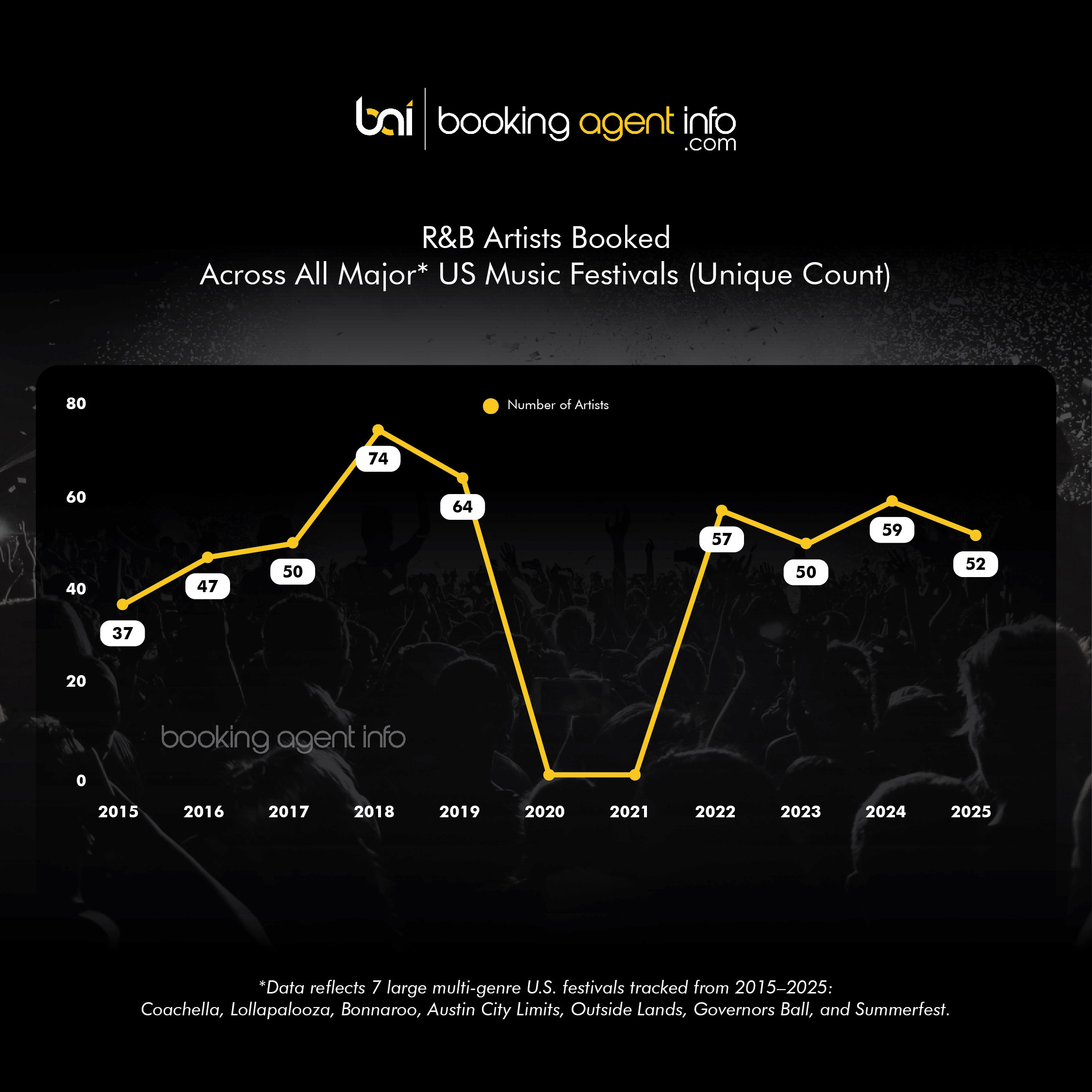
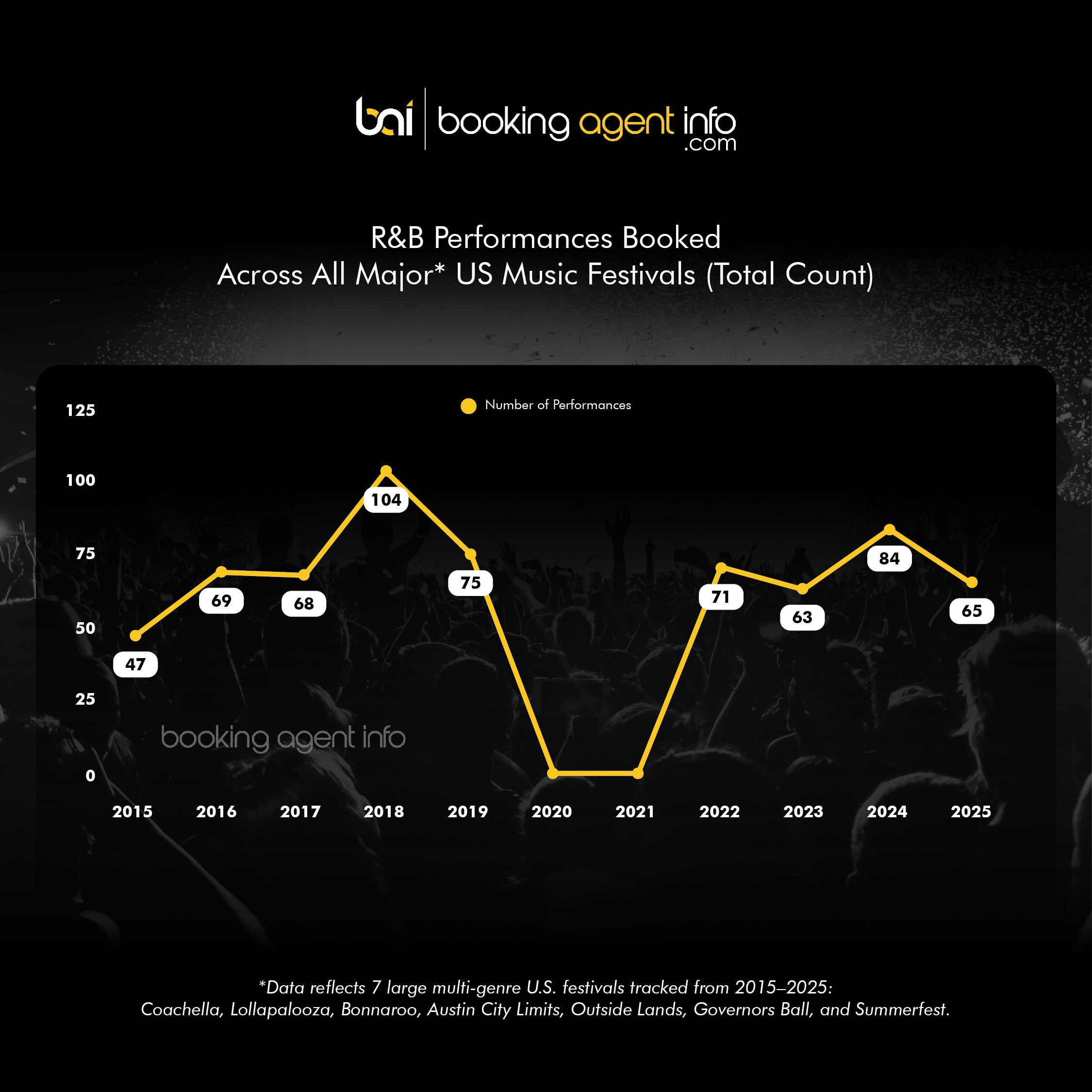
For a moment, R&B/Soul looked poised for a breakout. In 2018, the genre surged across major U.S. festivals with 104 performances from 74 unique artists — more than double the totals from just three years earlier.
But the rise was short-lived. By 2019, the numbers had already begun to slip. Then came the pandemic. The genre rebounded in 2022 with 71 performances, but the momentum never fully returned.
Instead of a clear growth trajectory, R&B/Soul has settled into a post-pandemic plateau. Between 2022 and 2025, the number of unique R&B/Soul artists hovered in the 50s, while total performances fluctuated modestly between 63 and 84.
In a festival landscape increasingly dominated by Electronic and Hip-Hop, R&B/Soul has found a steady — but smaller — footprint. And while its cultural influence remains strong, the booking data suggests festivals are keeping its presence modest.
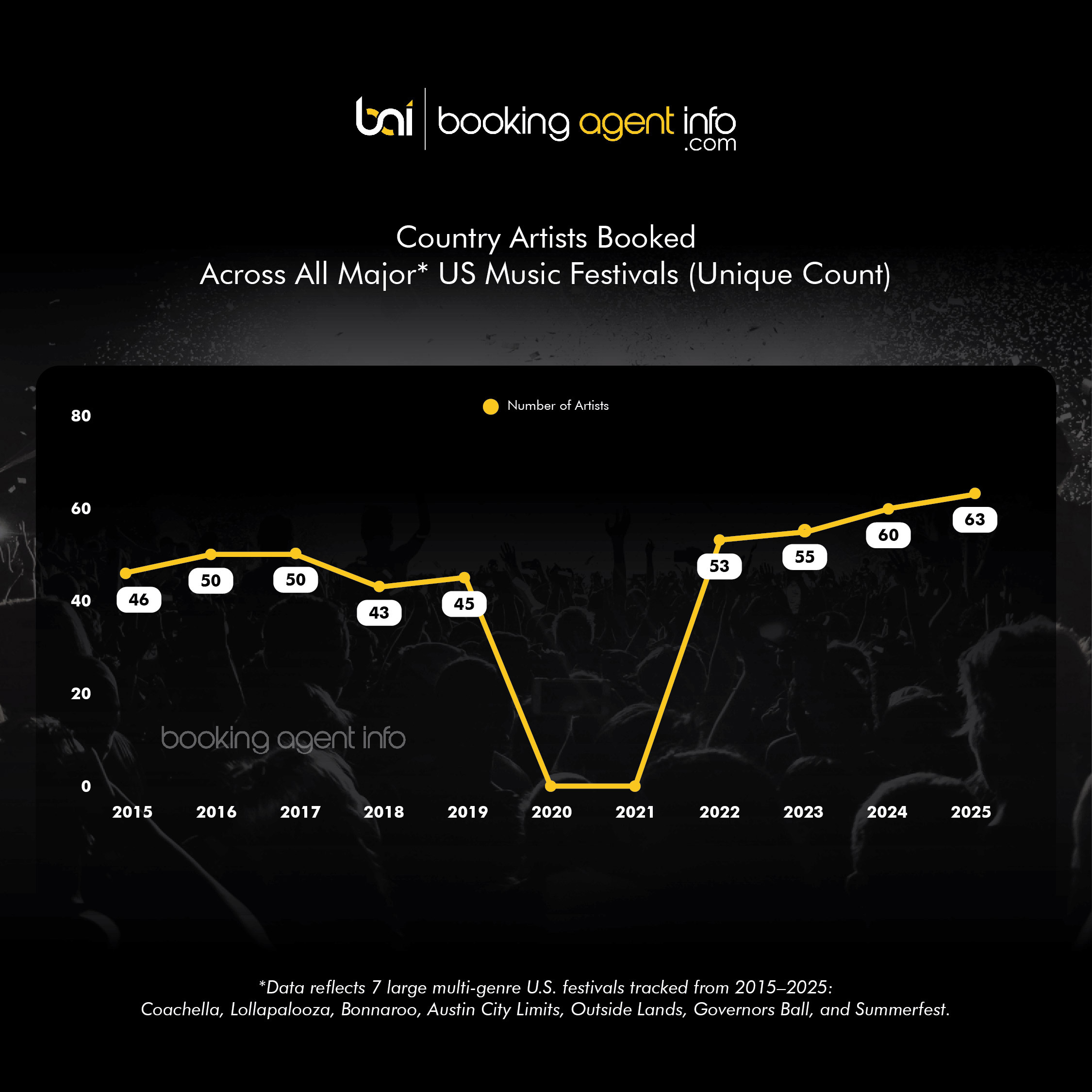
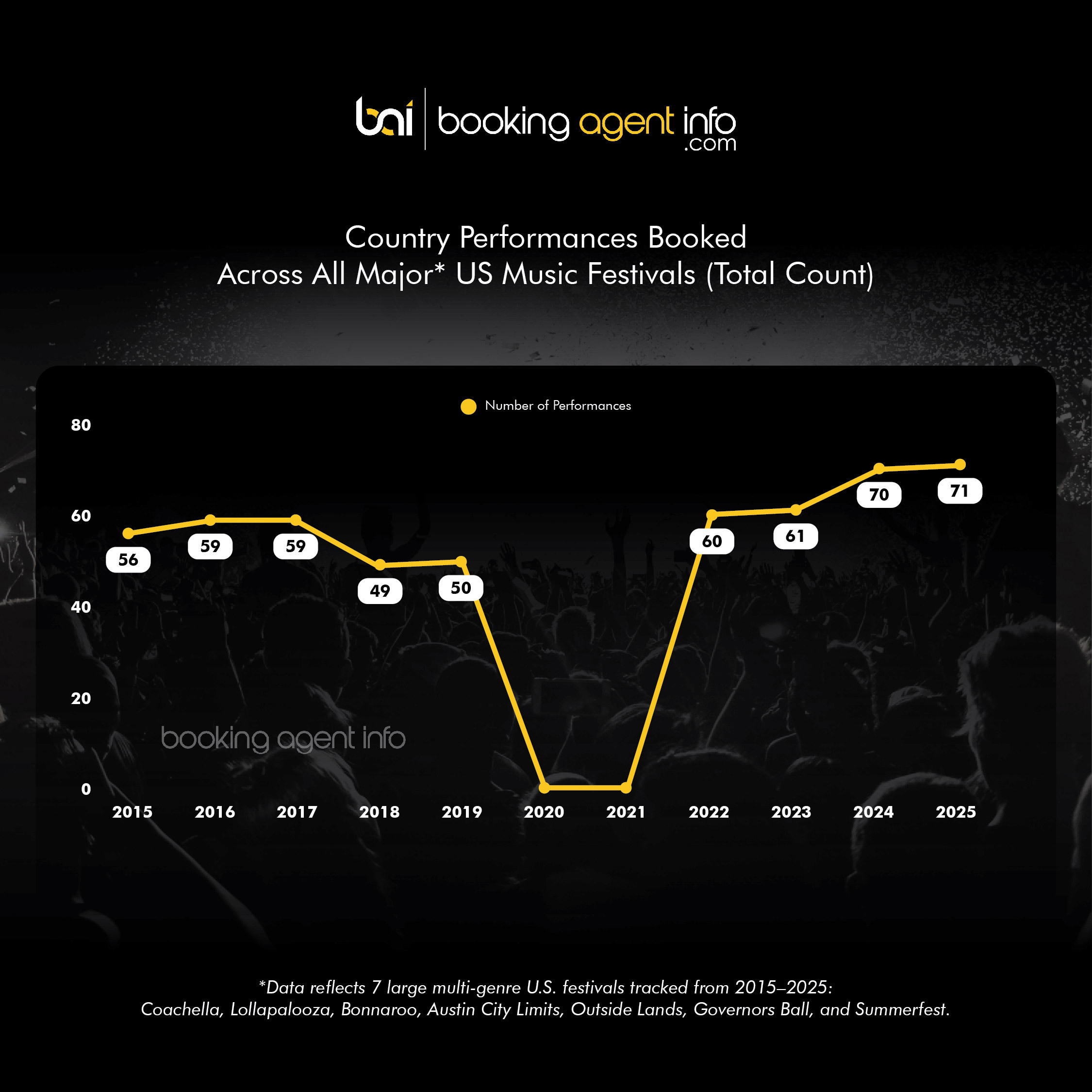
Country may not dominate the headlines, but its steady upward march across the past decade tells a more subtle story. While still the smallest of the core genres represented at major U.S. multi-genre festivals, Country music has quietly expanded its presence—especially in the post-pandemic era.
In 2015, just 46 unique country artists were booked across the seven major U.S. festivals we analyzed. By 2025, that number had climbed to 63, a more than 35% increase over the decade. The number of country performances also rose from 56 to 71, with growth accelerating after the pandemic disruption in 2020–2021.
This expansion coincides with the genre’s ongoing reinvention: crossover stars like Kacey Musgraves and Morgan Wallen, and genre-blurring collaborations with pop and hip-hop artists, have helped modernize its image. Still, Country’s slower growth compared to genres like Electronic or Hip-Hop may reflect a broader structural limit—it’s still not a dominant programming priority at most major multi-genre festivals.
So while Country might not be breaking out at breakneck speed, it’s gaining traction—quietly, steadily, and perhaps strategically.
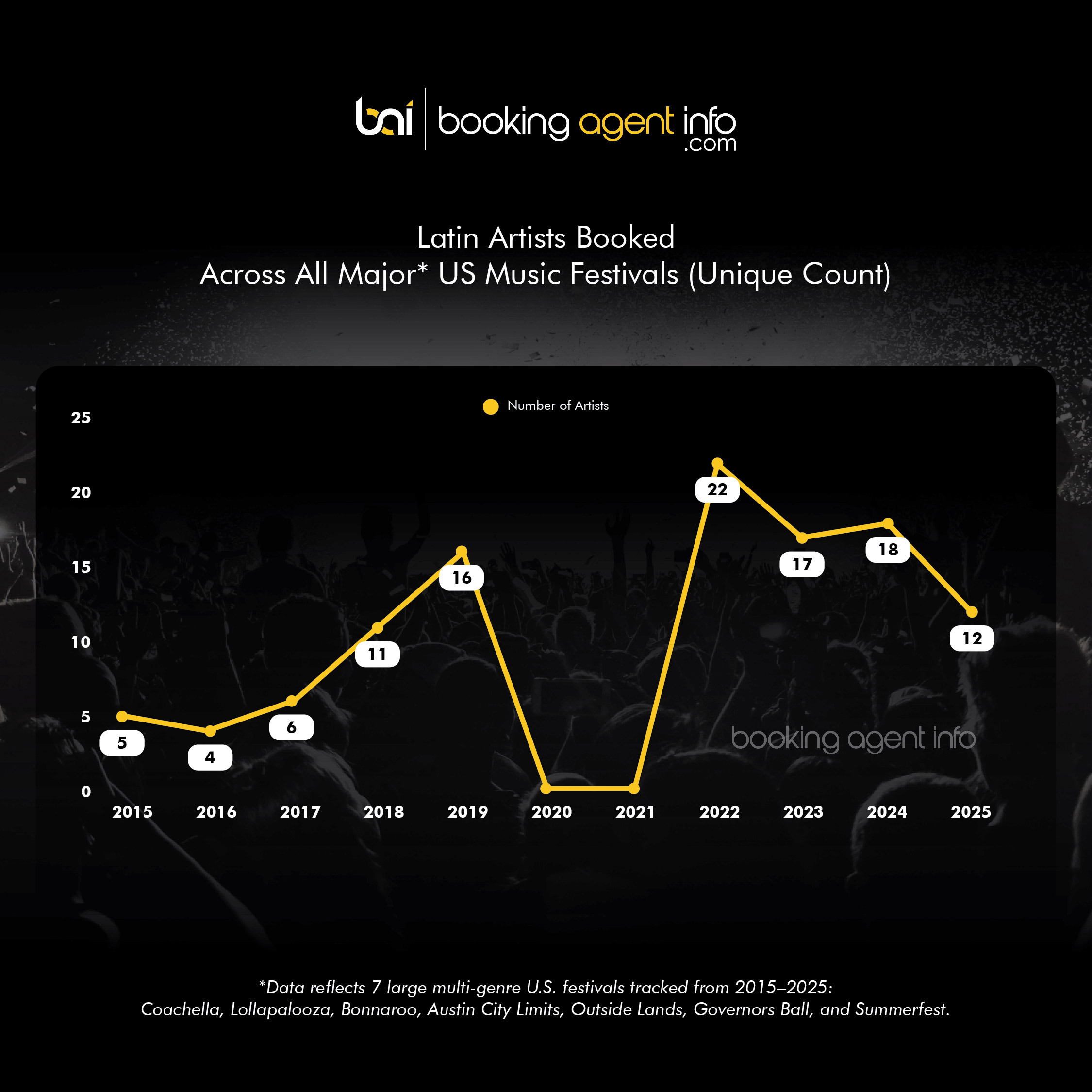
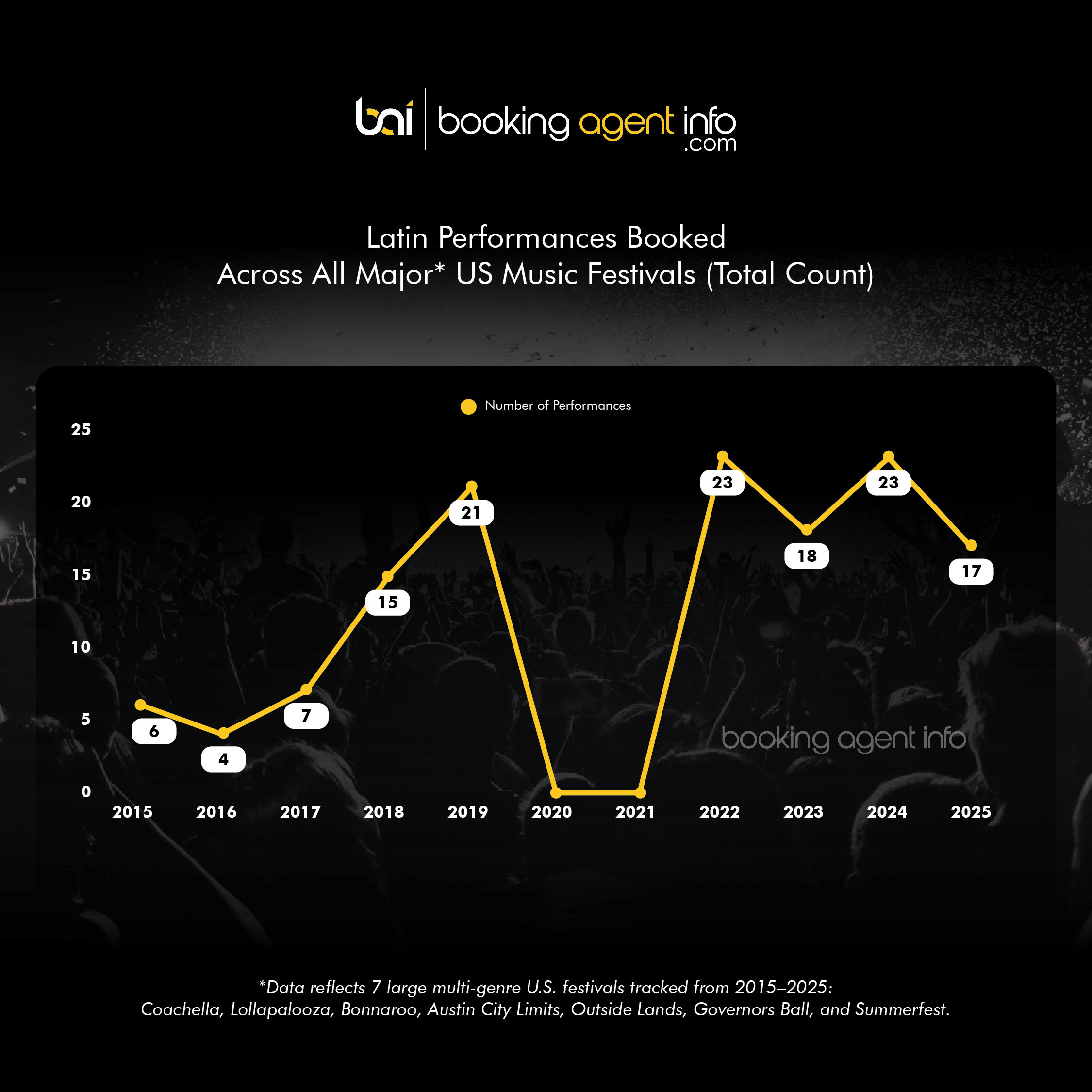
For most of the decade, Latin music at major U.S. festivals quietly edged upward. Starting in 2015 with just 6 Latin performances and 5 unique artists, it made modest but steady gains, hitting a peak in 2019 with 21 performances and 16 unique artists.
The post-pandemic rebound was surprisingly strong: 2022 recorded 23 Latin performances and 22 unique artists — the genre’s highest showing of the entire decade. But that bounce didn’t last. Since then, Latin bookings have slid, with 17 unique artists and only 12 performances in 2025, the lowest since 2017.
What changed? It’s not that Latin music lost cultural momentum — if anything, its global popularity continued to surge. But festival rosters don’t always reflect streaming trends. Despite headliners like Bad Bunny and Karol G drawing massive audiences, most U.S. multi-genre festivals still relegate Latin talent to just a handful of slots. Genre-focused events like Sueños and Baja Beach Fest — which weren’t included in this data — may better capture the genre’s growth. Still, for mainstream festivals, Latin’s step back in 2025 raises questions about whether bookers are missing the moment.
Summerfest is a programming outlier. Billed as the “World’s Largest Music Festival,” its sheer size makes it a data heavyweight—but not necessarily a representative one. It stretches across multiple weekends, packs in a heavy slate of rock performances, and leans far more traditional in genre curation. When it’s part of the dataset, Rock dominates. When it’s not, the entire festival landscape reshapes.
So what if we took it out?
With Summerfest in the mix, Rock reigns supreme across nearly every year. But the moment it’s pulled, a very different genre takes the throne: Electronic.
In 2023, 2024, and 2025, Electronic pulls ahead of Rock in both total number of performances and unique artists. By 2025, Electronic boasts 220 total performances and 192 unique artists, surpassing Rock’s 194 performances and 148 artists. That’s not a statistical footnote—it’s a genre coup.
Dance music isn’t just back. It’s on top.
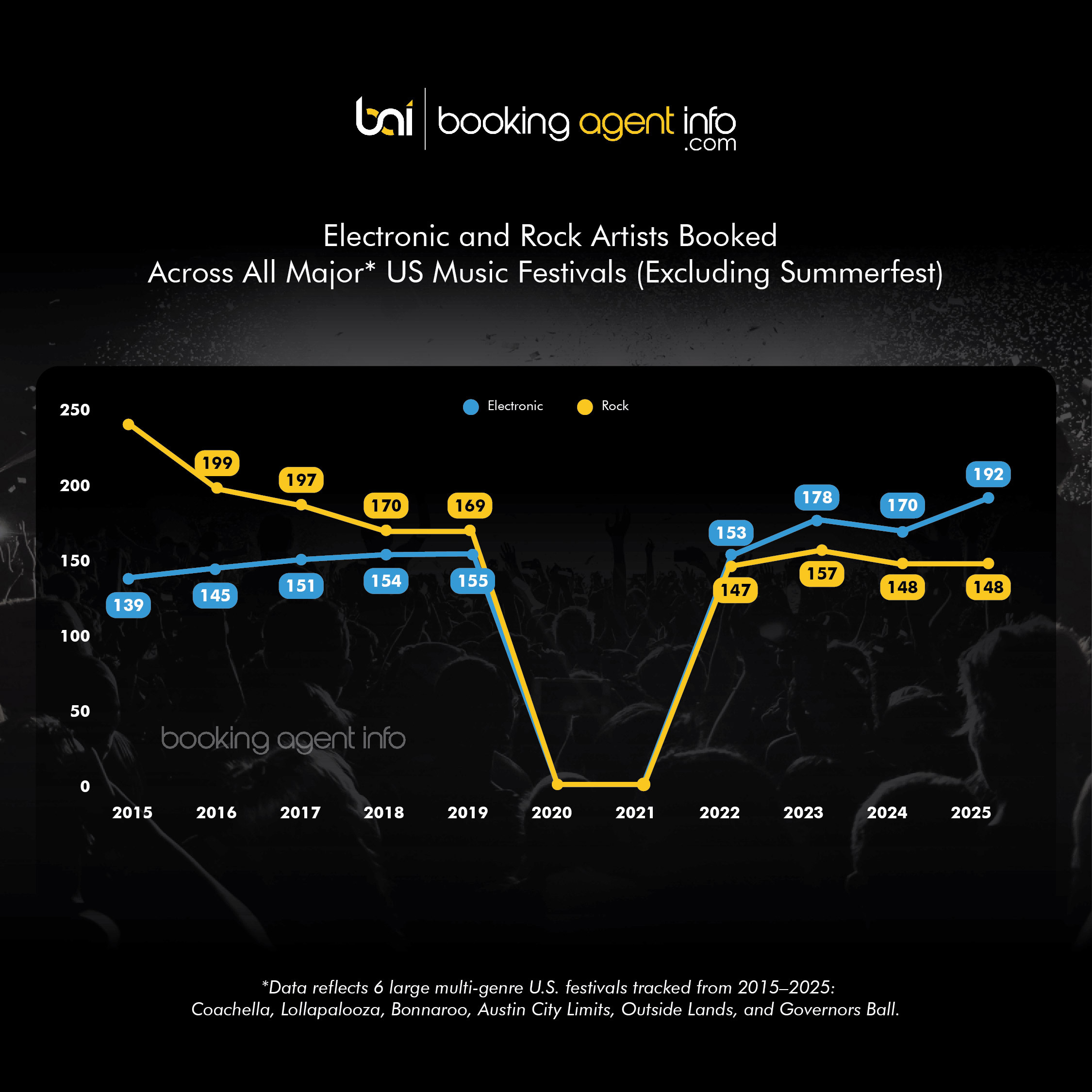
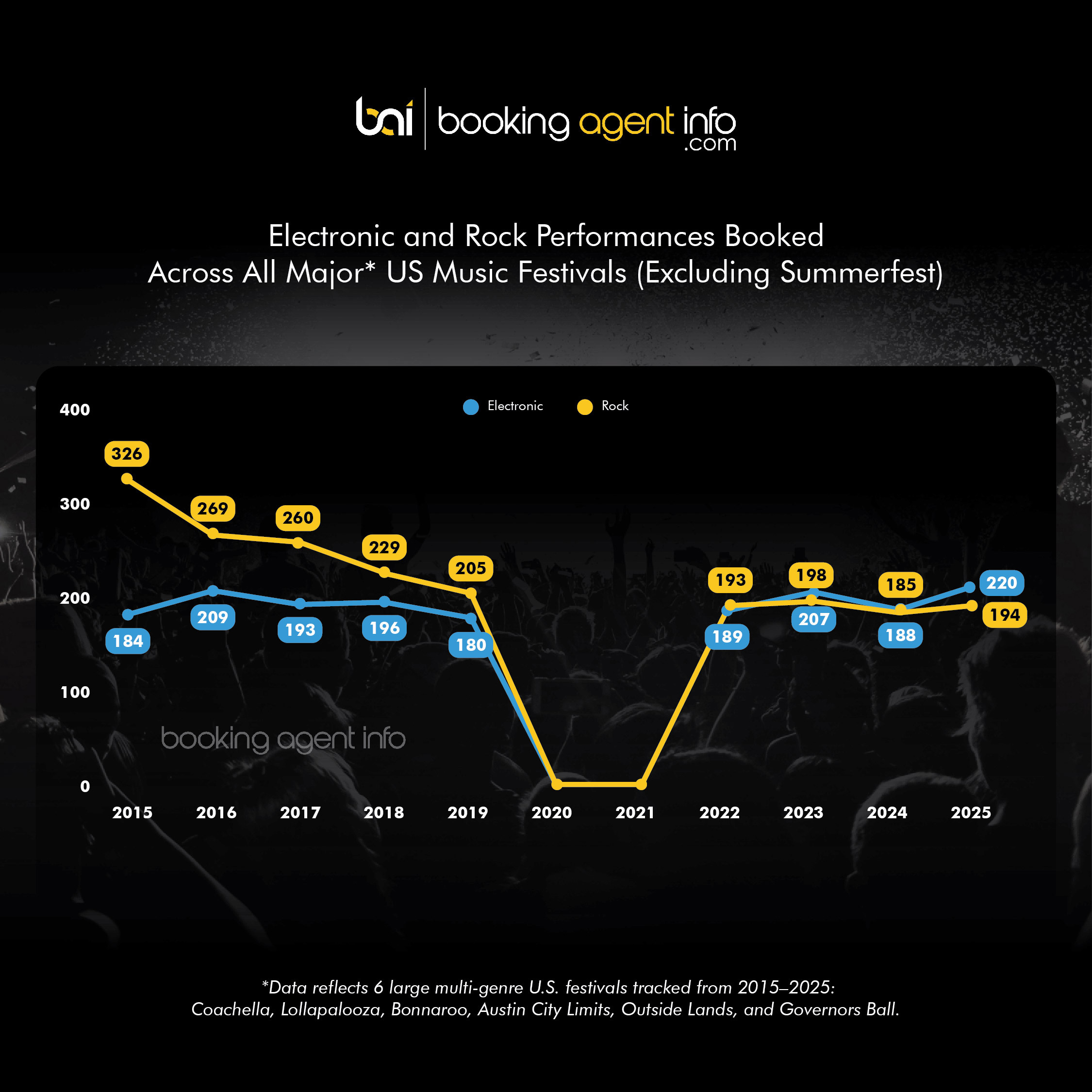
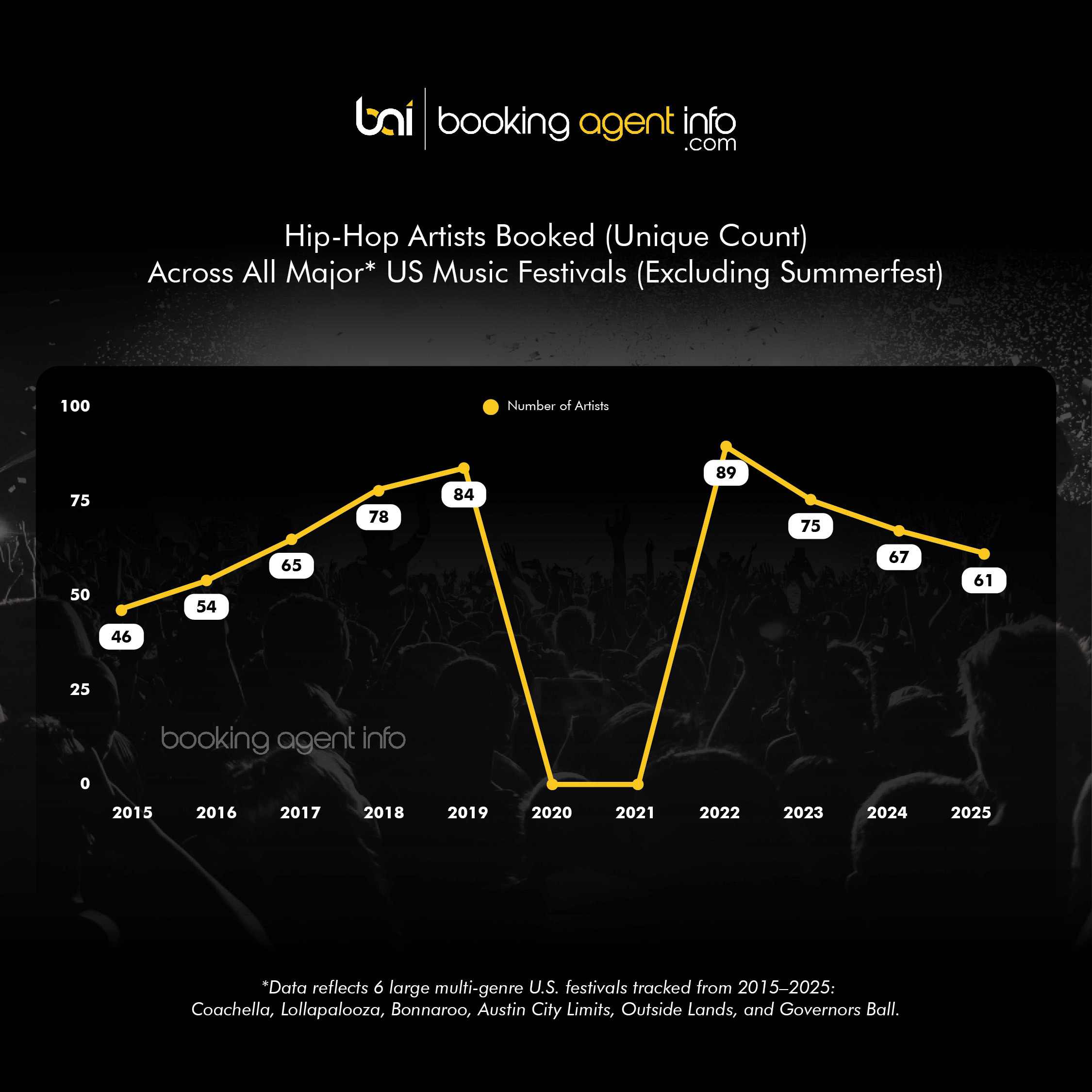
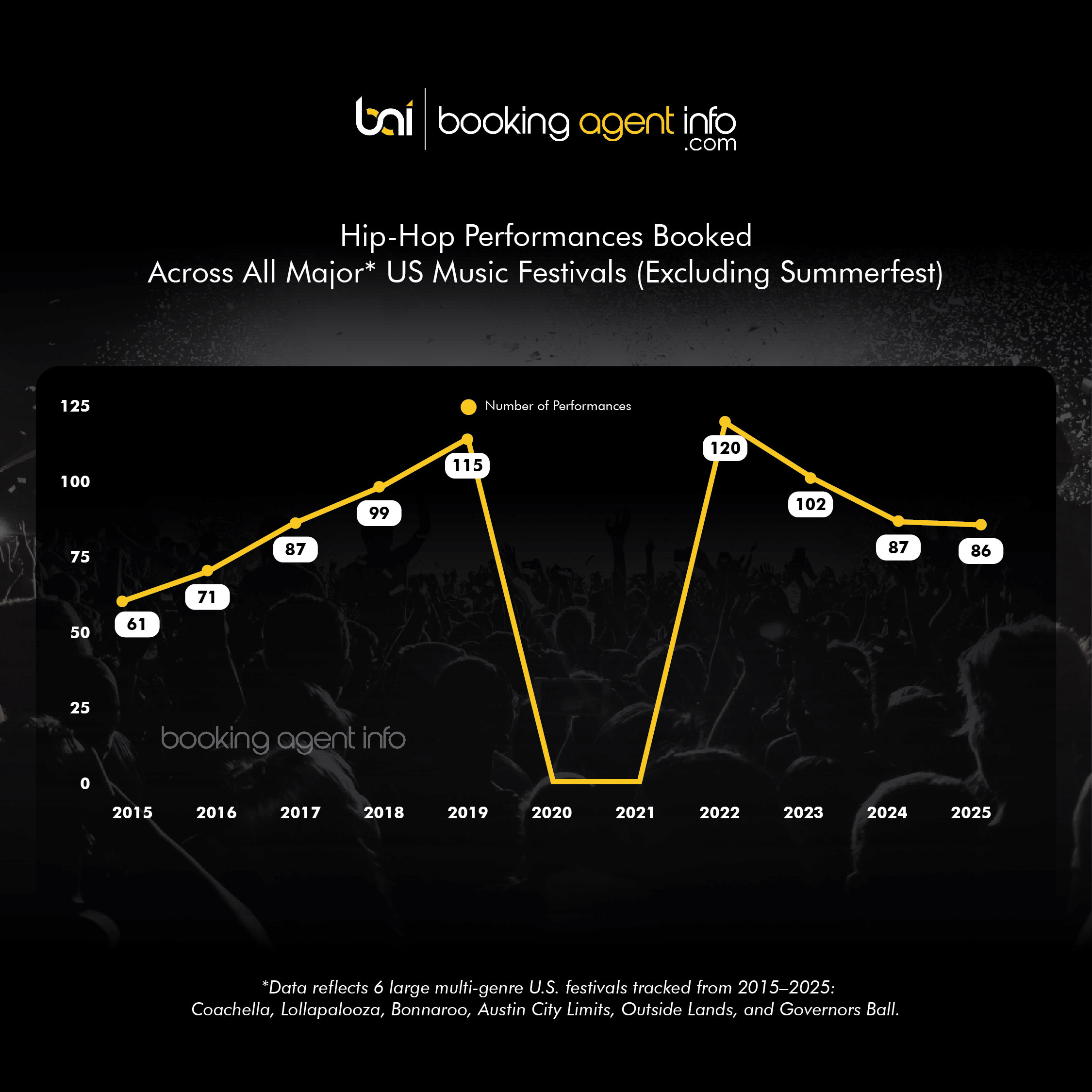
Remove Summerfest, and another trend comes into sharper focus: Hip-Hop’s rise… and recent slide.
The genre grew steadily through the 2010s, culminating in a post-pandemic spike—120 total performances in 2022. But then, the momentum fades. By 2025, Hip-Hop falls to just 86 performances and 61 unique artists—its lowest since 2018.
That drop-off doesn’t get much attention when Summerfest is skewing everything. But without it, the post-peak softening becomes undeniable.
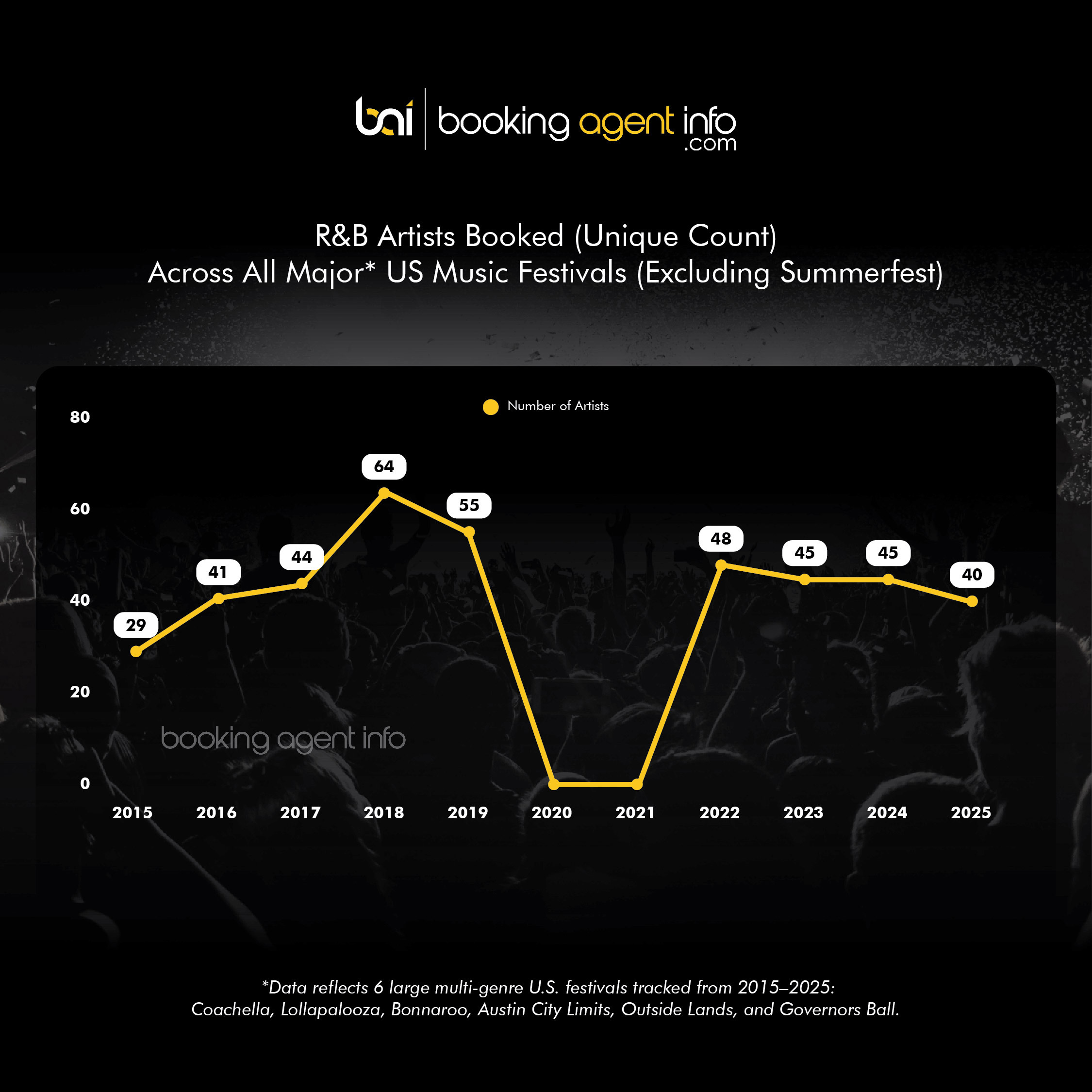
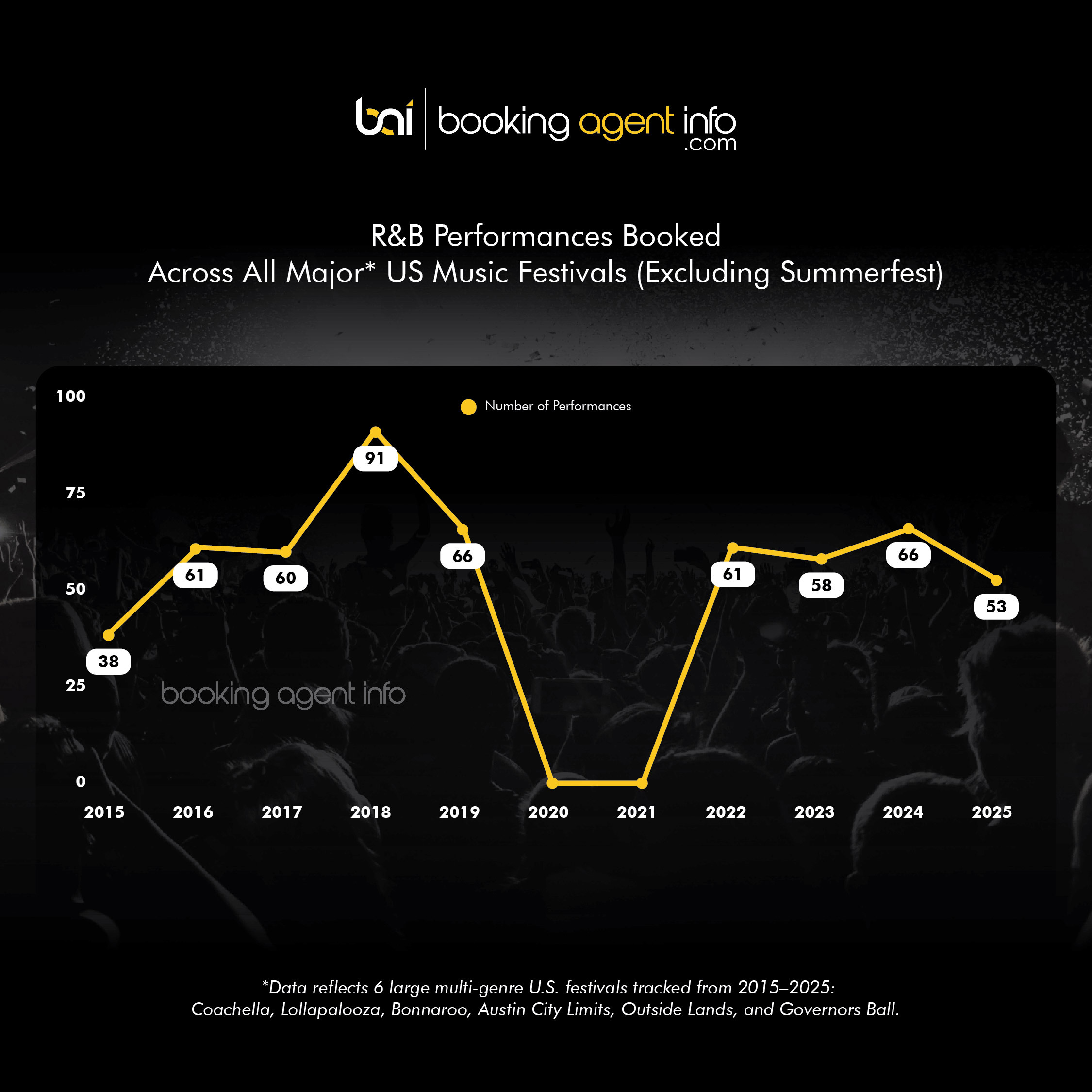
When Summerfest is removed from the dataset, the story of R&B/Soul becomes even more striking. After peaking with 64 unique artists in 2018, bookings have steadily declined — dropping to just 40 by 2025. That’s a 37.5% decrease in unique R&B artists from its peak year.
This raises an uncomfortable but important question: Why is one of music’s most influential genres struggling for visibility at major U.S. multi-genre festivals?
Even as the overall festival circuit rebounded post-COVID, R&B didn’t recover at the same pace. Its booking slump suggests an ongoing disconnect between festival curation and the genre’s popularity on streaming platforms and award stages.
Without Summerfest’s gravitational pull, the festival landscape reshuffles—and long-hidden trends come into sharper focus:
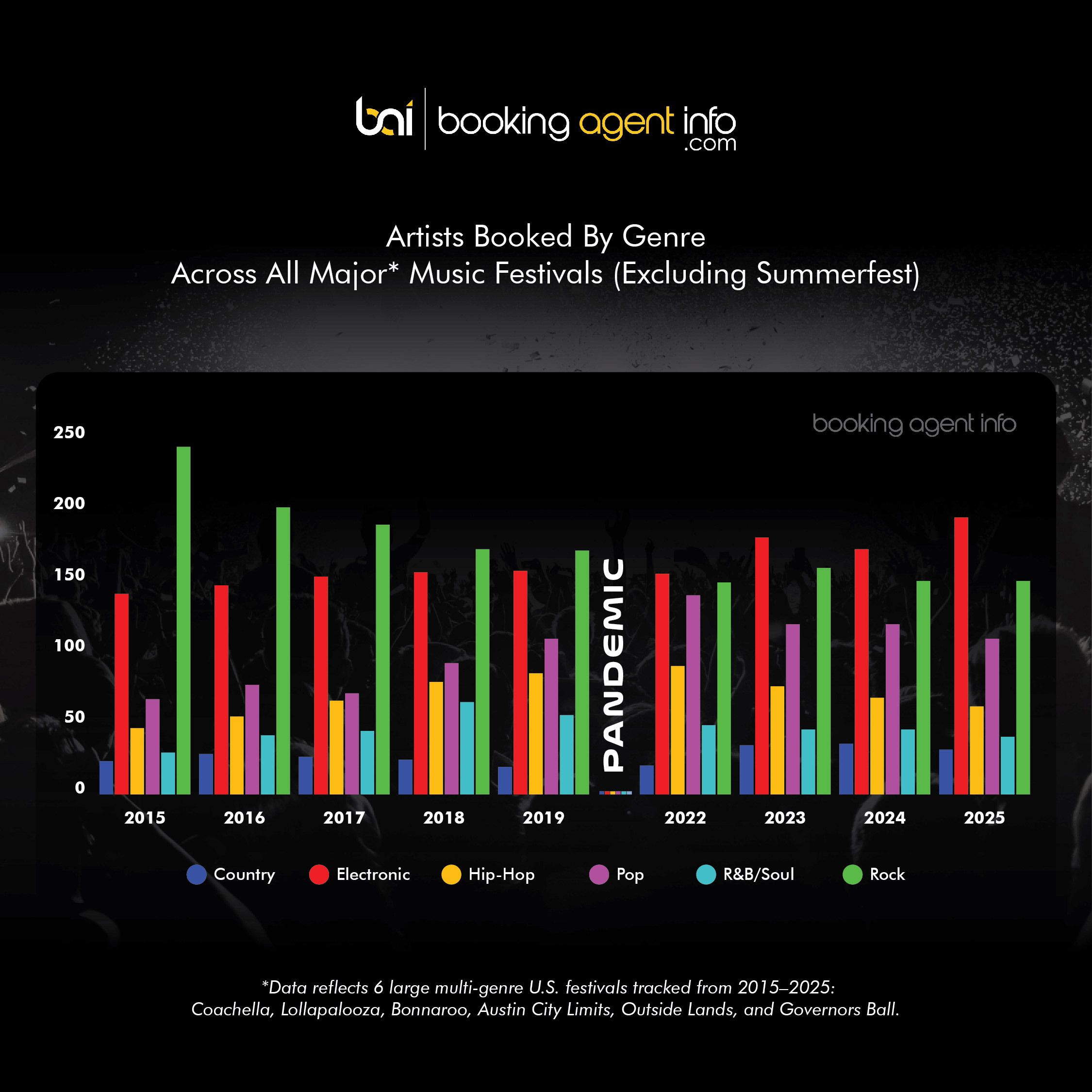
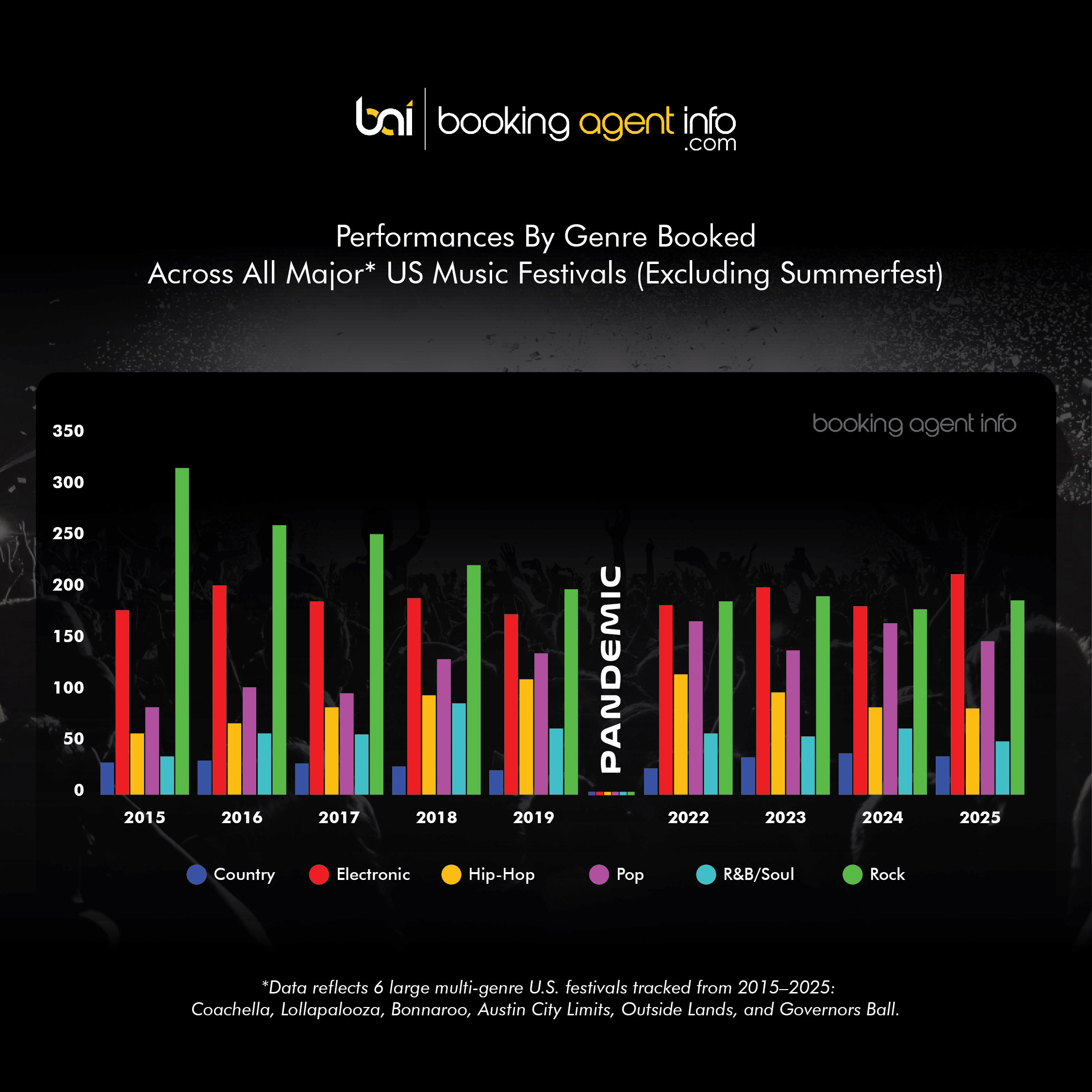
Summerfest doesn’t just tip the scales. It warps the picture. When you remove it, Electronic is the top genre in the U.S. festival circuit. Hip-Hop looks less like a rocket ship and more like a bell curve. And Pop keeps playing the long game.
Sometimes, to see what’s really happening, you have to take out the loudest voice in the room.
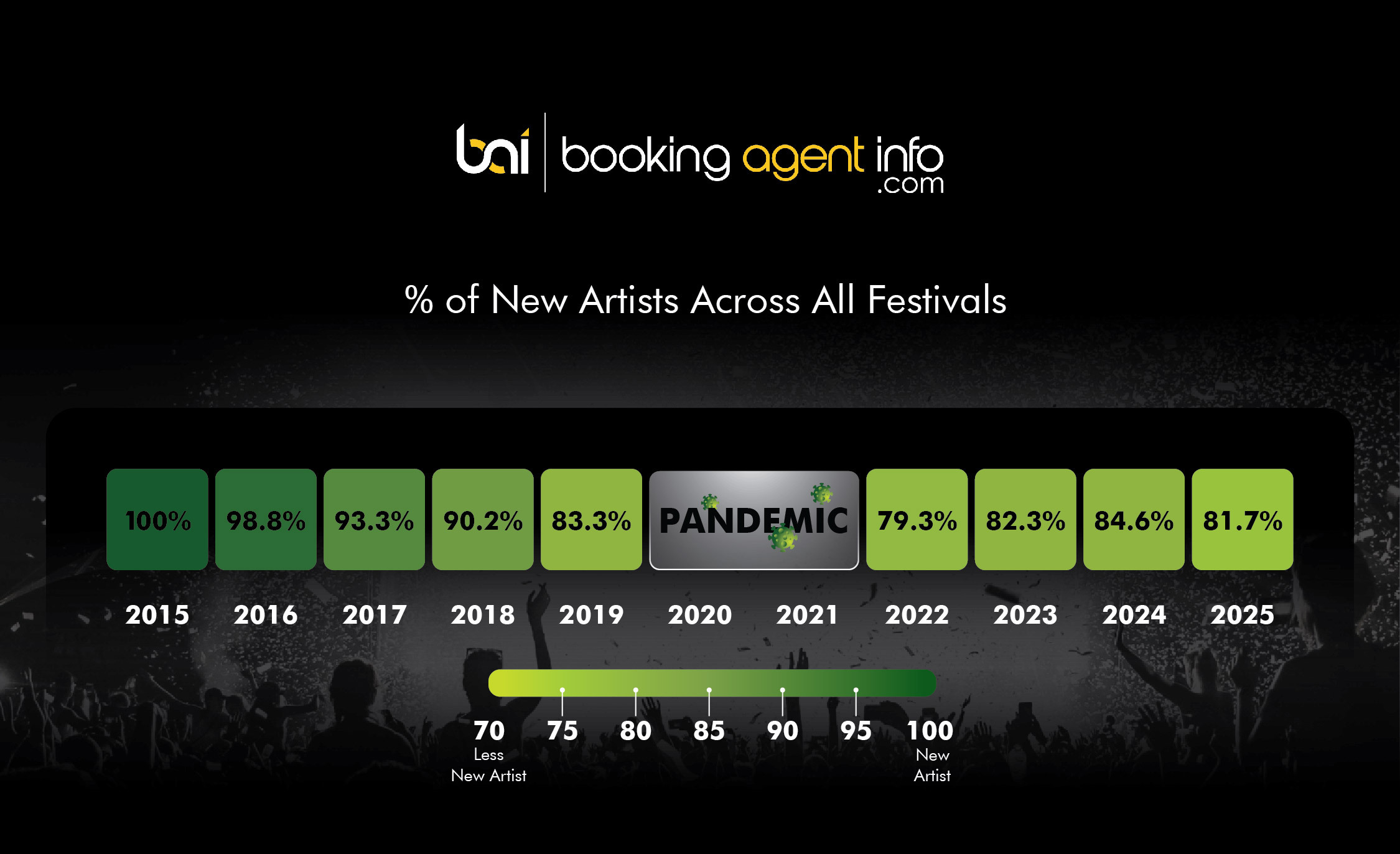
Beyond genres, another quiet shift has taken place: the rotation of talent. How often are festivals refreshing their lineups with new names — and how often are they leaning on familiar faces?
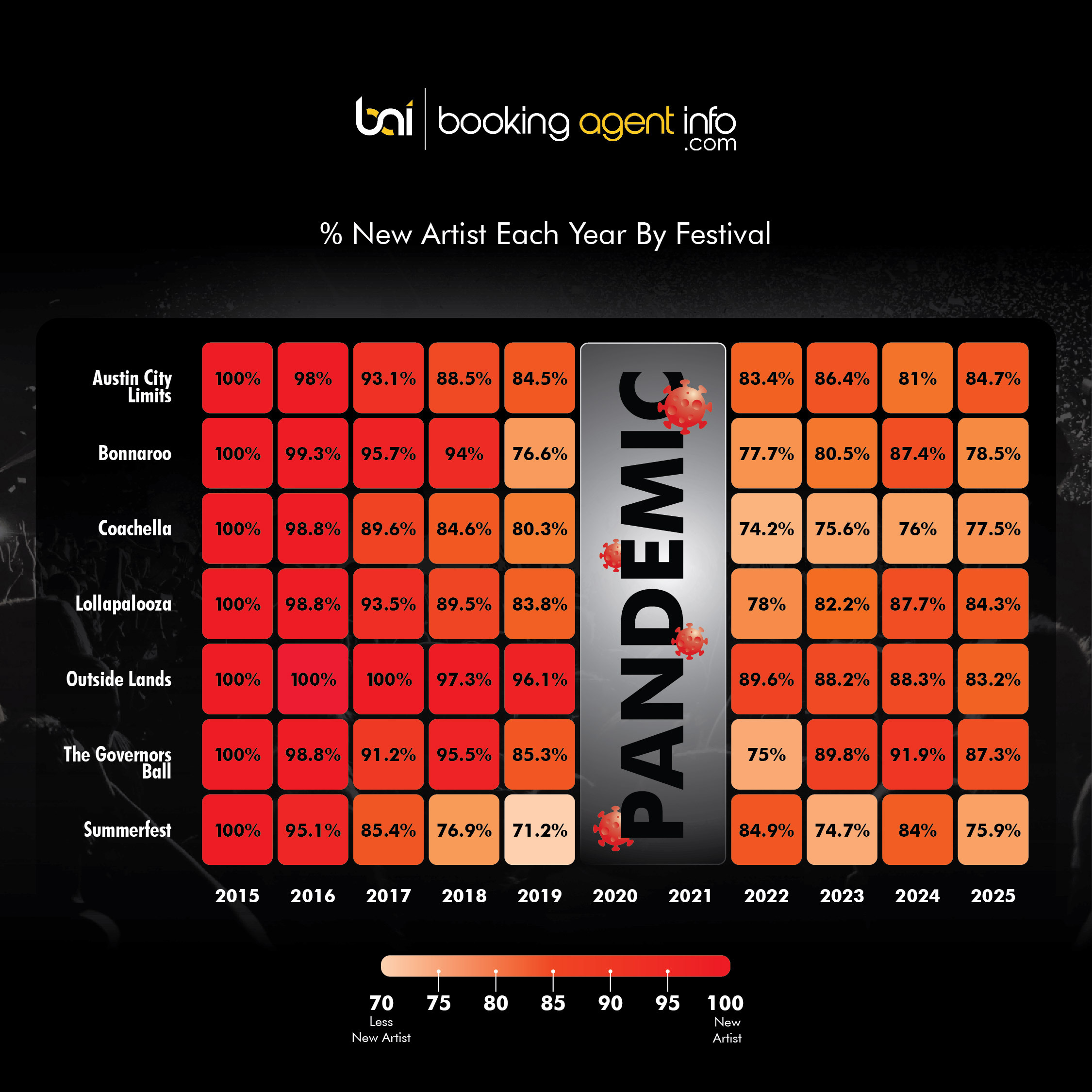
In 2015, every artist was new to the dataset by definition. But over the next decade, that freshness steadily declined. By 2025, just 80.2% of artists booked at U.S. festivals were new to that year — meaning nearly 1 in 5 artists had played the circuit before.
Some festivals kept their rosters rotating at a high rate:
Others saw a sharper drop:
Festival lineups have always reflected the cultural moment. But now more than ever, they also reflect how often that moment repeats.
If the 2010s were about the gradual diversification of festival lineups, the 2020s turned that trend into a full-scale genre upheaval. Across the decade, U.S. music festivals didn’t just shift — they redefined themselves.
Rock, once the anchor of every major lineup, saw its dominance fracture year after year. At Coachella, rock acts shrank from 53 in 2015 to just 38 in 2025. At Lollapalooza, they held on slightly longer but were eventually matched — and in some years, outpaced — by the rise of Electronic and Pop. At Bonnaroo and Outside Lands, the erosion was more gradual but undeniable. Even Summerfest, the most rock-heavy holdout, saw its numbers splinter by 2023 before roaring back in 2025 with a final spike. Still, it was a final gasp, not a resurgence.
In its place, Electronic emerged as the most consistent climber. Festivals that once booked DJs as late-night tent fillers now feature them as headliners. By 2025, Coachella booked 111 electronic acts — more than half its lineup. Outside Lands and ACL followed similar arcs, with electronic artists becoming the connective tissue across genres and generations.
Hip-Hop, meanwhile, experienced a pandemic-era peak. In 2022 and 2023, as live events came roaring back, hip-hop acts surged — boosted by headliners like Kendrick Lamar, Travis Scott, and Doja Cat. But by 2024 and 2025, the numbers slipped. Hip-Hop didn’t disappear, but its novelty wore off. It settled into a mid-decade plateau: essential, but no longer ascendant.
Pop proved the steadiest hand through it all — a flexible, shape-shifting genre that adapted to the moment. Whether hyperpop, retro synth-pop, or Taylor Swift stadium-era domination, pop remained a reliable pillar. It didn’t need a revolution; it quietly thrived.
And then came the genre-benders. Latin acts surged, often appearing under pop or hip-hop banners but bringing their own global force. K-pop crept into major festivals, especially post-2022. R&B/Soul saw a subtle revival. Jazz, reggae, and country stayed small but persistent — serving as flavor, not foundation.
All this happened against the backdrop of external shocks: a two-year live music freeze, algorithmic taste-making, globalized fandoms, and streaming culture’s shift toward playlists over albums. The post-pandemic return didn’t restore the old balance — it accelerated new ones.
By 2025, genre lines were blurrier, lineups were bigger, and the definition of a “festival act” had evolved. Headliners came from TikTok as often as they did from Rolling Stone covers. The crowds wanted more than music — they wanted moments, mashups, and meaning.
The result? A new kind of festival ecosystem — less predictable, more pluralistic.
If the first half of the 2010s was about preserving tradition, the second half — and the post-COVID years especially — were about burning the old playbook and building something entirely new. And as we head toward 2030, one thing’s certain: the most booked genre might not even have a name yet.
Like this type of content? Subscribe to our newsletter: DealDigest